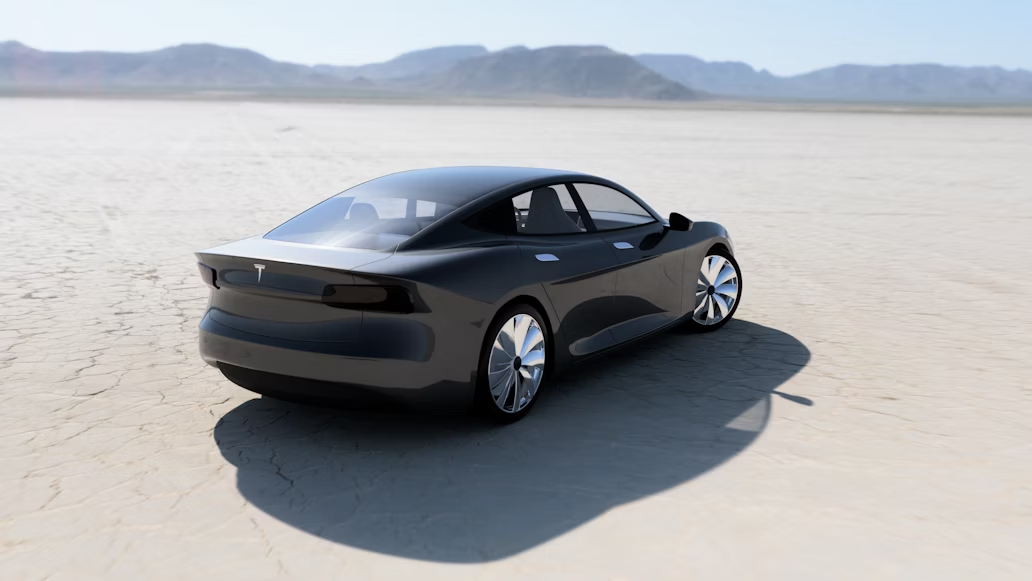
Each year, manufacturers test new concepts with newly designed vehicles, concepts and ideas. They may innovate ideas within new tech and styles that eventually become a market standard. Building faster vehicles and faster means less to the manufacturers. Most new concept vehicles in the next years are designed with a new sense for a new and changing world. New vehicles designed with and around self-sustainable materials have a drove their attention towards how self-driving and automated vehicles will allow a new experience to passengers. Their imagination has a new perception. This has a strong resemblance to the way the creative world pushes boundaries. Interdisciplinary innovation has become a trend, particularly in gaming. For example, mine island smartsoft illustrates how attracting new audiences seems to have little correlation with traditional approaches and more with bold new ideas.
Interiors That Do More Than Drive
The most visible trend in concept cars for 2025 are the diminishing cars that have a steering wheel and all the control and functionality of the driver seat. More and more new models have open concept, lounge, and office. New seated vehicles with the wheel and all control functionality removed and are much more are designed around the new perception of automated driving.
Design ideas for shared media include swivel chairs, foldable tables, and even large digital screens. This brings up considerations concerning the car’s role in everyday activities. Will cars stay private, or turn into mobile workplaces? While this depends on the speed at which complete autonomy becomes dependable, there are already ongoing tests.
Energy Systems Under Pressure
There is the theme of the Pressured Systems on Energy. Most designs show the use of electricity, which is understandable, but there has also been interest in the production and recycling of batteries. Some 2025 concept cars focus on modular designs in which users can swap out smaller batteries for flexible charging during long trips and use new solid-state batteries.
There is also the conversation of using different materials for building batteries to lessen the reliance on scarce resources. Whether these concepts will be feasible for mass production is the focus of the engineers with the concept cars. This is also in order to provide the public, regulators, and investors with something meaningful to critique.
The Expanding Role of Artificial Intelligence
The incorporation of AI into vehicle design is not something new, but its use with concept cars of 2025 is vastly different. AI goes beyond omnipotent navigation and collision avoidance systems and is portrayed as something close to a co-driver or an assistant. Automobiles are envisioned to be systems that adjust to a user’s environment, anticipate user demands, and possess the ability to converse with surrounding hyper-structures.
For example, some concept vehicles are designed to assess the stress levels of users and alter the ambience and environment within the vehicle by adjusting the lights and changing the temperature. Other concepts suggest the coordination of vehicles in a flowing traffic scenario, or the ability to self-determine the flow of traffic to maximize the efficiency of vehicle movement. While these concepts are in the early stages of development and extremely far from commercialization, they are a paradigm shift in the ability of vehicles to self-act without the need for constant human input
Digital Connectivity as Standard
Integration with digital networks is one of the more pragmatic proposals that was showcased. In-vehicle systems and interfaces are designed as connected digital hubs that link efficiently with personal devices, workplace interfaces, and entertainment systems. Rather than having each passenger immersed in their own personal device, vehicle interiors are designed for shared spatial digital use, with screens designed for group-oriented and spatially visible interfaces.
The potential for travel in these situations will be interesting to explore. We could have meetings during our commutes or even have work collaborations during long-distance travel through multiplayer games or streaming. At the same time, there will be issues of distraction and the balance of personal time and corporate expectations. The potential of corporate overreach is a real Issue.
Design Choices with a Purpose
Although futuristic designs often seem to lack a rational basis, many designs of 2025 focus on the function of various shapes and structures. As the battery range of electric cars is a limiting factor, aerodynamic efficiency is and will remain a priority. We will continue to see moving and adaptive surfaces on vehicles as they will be designed for specific driving conditions.
Modular construction is another paradigm the industry is looking to explore. For the time being, the imagination of city cars that extend and adapt is just that, imagination. While these ideas will be in the experimental phase for a while, they will focus on reshaping the mobile ownership concept on a flexible basis.
Cultural Impacts of Future Mobility
Concept cars have helped us reflect on the changing perceptions of automobiles. They are no longer viewed purely as status symbols, but as vehicles that accommodate various aspects of modern mobility. Some cars are envisioned to be shared, while others are designed to function as work, wellness, or recreation spaces on the go.
This change brings forward several practical concerns. If vehicles are designed to cater to the needs of mobile offices or in-car entertainment centers, there is little doubt that city planners would have to rethink urban infrastructure. The nature of private vehicle ownership is also brought into question. Although concept cars are not invoked as futuristic designs, they stimulate the necessary debate in the public forum.
Conclusion
Concept cars introduced in 2025 should be viewed in the context of advanced automotive designs, not the future of mobility. The designs should be understood in the context of design mobility technologies which are advanced. The incorporation of concepts such as autonomy, digitalization, and novel interiors, illustrates the needs that exist in the automotive industry.
These ideas are valuable for how they expand the discussion. They illustrate potential scenarios that could unfold if technology and society progress along particular pathways. The realization of these scenarios hinges on economic factors, regulations, and the choices made by consumers. However, the sheer effort being put into reimagining the automobile indicates that the future of mobility will likely differ from what we know today.