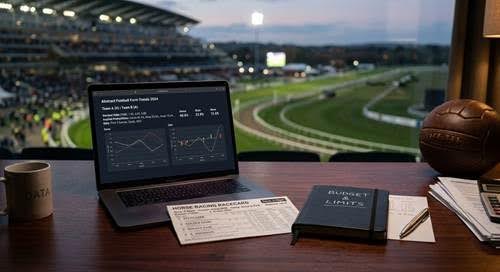
It’s good to get a start from a decent football form guide, but this is only a beginning. The true meat is be able to make a ‘real’ view of the match from what you’ve seen, read and measured, and to compare that ‘real’ view with the offer price.
That’s easy to say and difficult to do, actually, but many people make that mistake with their matches. It’s possible for a team to be performing well in a game but spending too much. Even if a side boasts a “legends” name, it can still lack the players of a system. Even the best of home-win stories is still a possibility and not a certainty.
The same train of thought can extend to other sports markets, but the evidence you use needs to be specific to the sport. Kicking things off with the sport everyone starts with: football.
Start with football evidence, not a hunch
Football form is not just five games in-that’s-it-outтий shown in a league table. The results are definitely significant, but they must be viewed with a context. Some of these four-win teams might have faced weaker challenges, had two red cards or had an unusually high number of goals scored.
It’s much more helpful for me to prepare a brief evidence sheet in advance of taking a stand. There is no need for a complicated spreadsheet or a Maths degree. It takes a little asking the right questions.
The details worth checking before a match
A decent football checklist could consist of:
- Recent performances, rather than results alone
- Home and away records, since some sides look very different on their travels
- Team news, including injuries, suspensions and likely rotation
- Fixture pressure, such as a cup tie, European match or short turnaround
- Underlying numbers, including chances created and conceded
- Motivation and league position, considered carefully rather than assumed
- The market price, which tells you what is already reflected in the odds
Play on an inside half. Often it’s easy to call it a day right there, especially when the opposition are playing lower down the table. Did the wins come easy, however? Were there enough points to justify them at the side? Does it have to rely on the replacement of its No 1 Centre-back? Do the poor/good form reflexes from the visitors reflect any poor/good luck?
Football is not predictable if it is this kind of questions that are asked. All they’re doing is allowing you to rise above the generalized statement “this team will win” and make a more honest statement about what you believe given the evidence available: “I think that this outcome may be more probable than the price because of the evidence on hand.”
That distinction matters.
The daily work routine can maintain the smoothness of the process. Those who follow FocusPredict’s everyday tips may start first with the day issues covered by experts then proceed to the Prediction hub to look at the fixtures that need to be watched. It isn’t the number of opinions that are the goal. It’s to cut short the card down to options containing the info, your perception and the offered amount that can be accessed in a relaxed manner.
Note an approximate probability for each fixture. Assume that your team has a probability of about 0.55 of winning their next game. If you are wrong (and you’re probably going to be, so much so that it’s something a character wouldn’t have been able to make up his own mind on his own), by putting a number on the opinion, you make vague confidence do less work.
Odds are prices, not predictions carved in stone
Having a football view, the next question is easily, quite simply: What do the odds tell you about the probability?
The basic formula for decimal odds is:
Implied probability = 1 / decimal odds x 100
So odds of 2.00 imply 50%. Odds of 1.50 imply roughly 66.7%. Odds of 3.00 imply roughly 33.3%.
If your probability is greater than the bookmaker’s probability, you might possibly have a volume that’s a thing to consider. It is better if it is below, but it may be popular, plausible and not even to the liking at that number.
Remember, there will always be a margin in a market so all the implied probabilities of the possible outcomes will not sum to 100% exactly. That’s so a hasty calculation should not be considered a definitive judgment.
A simple football example
Suppose that in 100 similar situations a home side wins 52 times. The payout is 2.10
- Your estimate: 52%
- Market-implied probability at 2.10: about 47.6%
- The Northern Area’s progress looks healthy, with a projected completion rate of 94.2% and a 4.4-percentage-point difference.
This doesn’t prove anything. It may be a reflection of information that you have missed or simply an idiosyncrasy in football. But it is more of a reason for your opinions than “they looked good last weekend”.
In the very tight markets, this is even more critical. A 100% correct score prediction is intriguing as it requires considering game shape, probable volume and defensive strengths. It is a challenging market, too, in that there are lots of possibilities. A 1-0 record can seem quite sensible before the match and can never be achieved by a deflection, an early injury or a late change.
It’s the same with a home-win selection. Backing the home side is possibly the form, the team news and the tactical match-up but football has far too many variables to be certain. A sending-off, a missed opportunity, or a goalkeeper having a great afternoon could change the course of a match in minutes.
The variance is not your fault. This is the sport! The prudent course is to proceed with moderation in language and judiciously regarding your choices.
Build a routine that can survive a bad weekend
You want to implement a limit to the good process. If not, it will be too easy to be discouraged and affect next time.
Enforce a maximum bet on play during an entire week, and establish a minimum value of the stakes ahead of time. Others like to have a flat stake on each and every choice. Some adopt a multi-point system, for example, one point for a regular view, and a point or a fraction of a point for a view where they have good clear, reasons. In any case, it is best to set rather than change the stake as a match feels a lot more legitimate.
The following is a useful routine:
- Review the fixtures and shortlist only the matches you understand.
- Check the evidence: form, absences, schedule, style and price.
- Record the reason for any selection in a sentence or two.
- Log the odds and stake before the match begins.
- Review afterwards, focusing on the quality of the decision rather than the result alone.
You could say for instance:”Home win, 2.05. Visitors lack two regular defenders; Home have been creating consistently at home; Price indicates under 49%”. That record will be much more valuable at the conclusion of the match than is the score-keeping sheet of wins and losses!
The PredictZ pages and daily tips hub is a great way to plan out the day’s football reading but it can best be used in conjunction with a plan such as reading, not instead of, it. Passing on is sometimes the more correct decision because if you don’t know why a match is interesting, you shouldn’t watch it.
After the game, there should be a review without bias. Be careful not to say that something is “bad” or “brilliant” because it didn’t win—or won—to imply it is a bad or brilliant choice, respectively. Discuss if the team news was correctly interpreted, even if the odds were as you had expected, and if you missed any red flags. As the years passed, those notes provide more clues about the extended period of outcomes than a brief spell of finds ever can.
Different sport, different inputs
The parts of the odds that don’t require a lot of discipline can be easily moved from one sport to another. Whether you’re viewing football, tennis or even racing, it’s beneficial to compare a view compared to the marketplace, set records and also establish limits. The evidence, however, should be appropriate to the event itself.
UK horse racing is NOT ‘football’ with different names. A football match lasts for 90 minutes, between two teams – and typically has a lot of tactical and performance data. A race consists of separate runners, each with their own profile, and a set of conditions which might completely alter the picture.
The main inquiries for racing are, however:
- What is the going, and has the surface changed?
- Is the distance suitable for the runner?
- How does the field size affect the contest?
- Does the racecourse layout suit the horse’s usual running style?
- What do recent runs say, including the class and conditions involved?
- Is there relevant jockey and trainer context?
- Has the draw or likely pace of the race shaped the market?
The form a runner may show in one distance on good ground may not be repeated on softer ground in another distance. Similarly, the hardest challenge is likely to be set on a horse who can set you up if a bunch of other horses will go up. These are not just affects, these are fundamental concepts of a Race.
In that context, that’s why the need for football analysis and racing research to stay separate is apparent. It’s not that with football one style of play can yield a racing response. In all markets, it is beneficial to have this careful record of evidence, comparison of odds, and honest record of decisions than the certainty claims.
Readers who want to understand that separate market can review horse betting on Bally Casino independently of FocusPredict’s football analysis.
Keep the aim sensible
The form guides, prediction pages and price comparisons are here to assist you with better questions. They can’t eliminate uncertainty and shouldn’t be used as a path to a promised end result.
Begin with their football evidence. Convert it to a probability (percentage) estimate. Do that comparison with the odds. Stakes are not removed, no re-writing history after full-time – documentation of larger arguments.
It may not be the most dramatic action, but it is the most helpful to make a clearer decision.