The new offside rule has attracted considerable attention as video technology and referee assistance systems become increasingly common in modern football. Many viewers still confuse proposals currently being tested with regulations that have already been officially implemented. Join Mitom TV as we explore how to determine an offside position, the key points to note, and common situations that occur on the pitch.
How should the new offside rule be understood?
Under the current Law 11 of IFAB, a player is in an offside position when any part of their head, body or feet is in the opponents’ half and closer to the opponents’ goal line than both the ball and the second-last opponent. The hands and arms are not considered when determining this position. More importantly, simply being in an offside position does not mean that the player has committed an offence.
This helps viewers understand that the new offside rule still relies on determining the player’s position at the moment a teammate plays or touches the ball. A player is only penalized when they become actively involved in the play from that position, such as directly playing the ball, interfering with an opponent or gaining an advantage from certain situations involving a rebound.
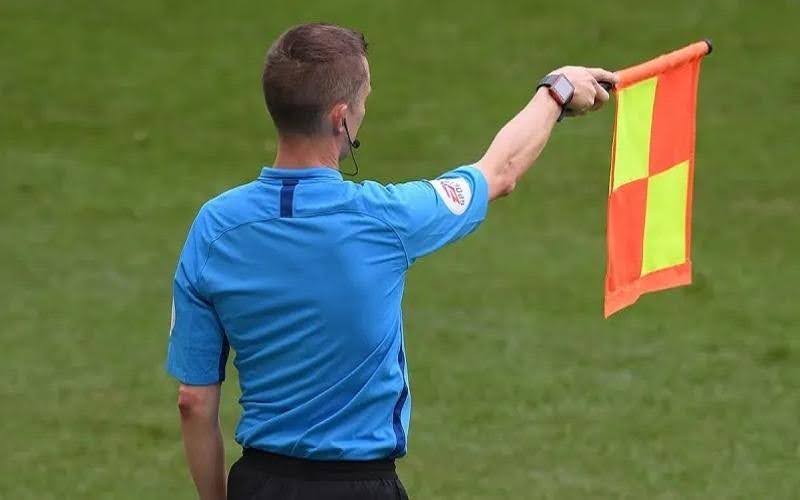
One point that is easily misunderstood is that proposals for significant changes to how offside is determined do not necessarily mean that they have become official rules applied widely. IFAB stated that offside-related trials would continue in 2026. Therefore, when watching truc tiep bong da, viewers should clearly distinguish between rules currently in force and new approaches that are still being tested.
According to Mi Tom TV, the simplest way to analyze an offside situation is to identify three factors: the moment the ball is played by a teammate, the attacking player’s position at that moment, and whether the player actually becomes involved in the play.
Key points to know when determining offside
To correctly understand a play, viewers should not simply look at whether the forward is standing behind the defensive line. The new offside rule must be considered through several consecutive conditions before the referee decides whether to award an offence.
Position is determined when the teammate plays the ball
The point in time used to determine an offside position is essentially when the ball is played or touched by a teammate. Therefore, a forward running beyond a defender after the pass has already been made does not automatically mean that the player is offside.
A player must also be in the opponents’ half to be considered in an offside position. If they are still in their own half when the teammate plays the ball, they can receive the pass and continue attacking even if only a few opposing players remain ahead of them. This rule is clearly stated by IFAB in the current version of Law 11.
Simply being behind the defensive line is not always an offence
This is a point that often confuses new football viewers. A player can be in an offside position, but if they do not touch the ball, challenge for the ball or interfere with an opponent’s ability to play the ball, the referee may allow play to continue.
For example, a forward standing near the goal but completely avoiding the goalkeeper’s line of sight and having no impact on a teammate’s shot may not be penalized. Conversely, if that player clearly obstructs the goalkeeper’s view or takes an action that directly affects the goalkeeper, an offside offence may be given.
The ball coming from an opponent can change the situation
Another situation to pay attention to is when a player is in an offside position but subsequently receives the ball from an opponent. If a defender deliberately plays the ball and sends it toward the attacking player, the situation may not be considered gaining an advantage from an offside position.
However, it is important to distinguish between a deliberate play by an opponent and a situation where the ball merely rebounds or changes direction off a defender. IFAB also distinguishes between an opponent deliberately playing the ball and a deliberate save made in front of the goal. This is a detail that Mitom TiVi often emphasizes when explaining controversial VAR situations.
Some plays do not involve an offside offence
A player is not penalized for offside if they receive the ball directly from a goal kick, throw-in or corner kick. For example, a forward may be positioned well behind the defensive line when a teammate takes a corner but is still allowed to receive the ball directly. IFAB confirms these situations in its guidance under Law 11.
Understanding these exceptions helps viewers avoid confusion when watching matches, particularly during set pieces where many players are concentrated near the goal.
How does technology affect the offside rule?
The most notable change in modern football is not only found in the wording of the rules but also in how referees determine situations. Semi-automated offside technology has been developed to assist VAR in making decisions more quickly, consistently and accurately.
At the 2026 FIFA World Cup, FIFA introduced enhanced semi-automated offside technology, allowing clear offside situations to be communicated more quickly to the referee on the pitch. The goal is to shorten the review process and prevent matches from continuing for too long after an offside offence has occurred.
Therefore, when referring to the new offside rule, it should not be understood that all previous principles have been replaced. In reality, most of the foundation of Law 11 remains in place, while technology is significantly changing the speed and accuracy of the decision-making process.
According to Mì Tôm Tivi, this is also why many situations involving extremely small margins can still be detected. For viewers accustomed to judging situations with the naked eye, a play that appears to be level may sometimes be identified by technology as being different by a very small distance.
One notable adjustment introduced in the 2025/26 Laws of the Game concerns situations in which a goalkeeper throws the ball: the final point of contact between the goalkeeper’s hand and the ball is used as the reference point for determining offside position, rather than the first point of contact. IFAB explained that this approach provides a clearer and more consistent reference point.
Offside situations that viewers often misunderstand
Many debates arise because viewers only observe the forward’s position while overlooking the exact moment the ball is played. When watching truc tiep bong da, it is important to pay attention to the moment the teammate touches the ball rather than the forward’s position after the ball has already traveled some distance.
Another situation occurs when the ball hits the post or crossbar and reaches a player who was previously in an offside position. If that player subsequently plays the ball, they may be penalized for gaining an advantage from their offside position. Similarly, a ball saved by the goalkeeper and then rebounding does not automatically erase the previous offside position.
Conversely, a player standing behind the defensive line but not becoming involved in the play is not necessarily committing an offence. This is why MitomTV often needs to review the entire sequence rather than relying on a single frame to explain the referee’s decision.
Understanding the new offside rule also helps fans read matches more effectively. A high defensive line can deliberately create an offside trap, while forwards must time their runs precisely. These details directly affect the ability to create chances, match results and even the bảng xếp hạng bóng đá after each round.
In addition, not every piece of information about a trial approach should be considered an officially changed rule. In 2026, IFAB continued testing new offside approaches rather than announcing that the entire current method of determining offside had been replaced. Distinguishing between these two concepts helps viewers avoid misunderstandings when reading the news.
How does the offside rule affect tactics?
Offside is not simply a regulation for referees to enforce; it also has a direct impact on how teams organize their tactics. Defenders can move forward together to put opposing forwards in an unfavorable position, while attacking teams must coordinate the timing of passes and runs precisely.
Teams that use a high defensive line generally require defenders to maintain their distances and move in sync. Just one defender staying deeper than the rest can break the offside trap and create space for the opponent to run into.
On the other hand, skilled forwards usually possess not only speed but also the ability to read the defensive line. They can stay level with a defender, take a step back or begin accelerating at exactly the moment their teammate plays the ball. These small movements can determine whether a player gets a one-on-one opportunity.
According to Mì Tôm TV, understanding how offside works also helps viewers better analyze why a team can create numerous chances but repeatedly be caught offside, or why a defensive line can neutralize through balls without directly winning possession.
These tactical factors can also have a long-term impact on goals scored, goal difference and the bảng xếp hạng bóng đá, because a single offside decision that is correctly or incorrectly given can change the course of a match.
Conclusion
Understanding the new offside rule correctly helps viewers distinguish between an offside position and an offside offence while also making VAR decisions easier to follow. New trials do not mean that the entire current Law 11 has been replaced. Stay with Mitom to continue updating your football knowledge and gain a better understanding of notable situations on the pitch.