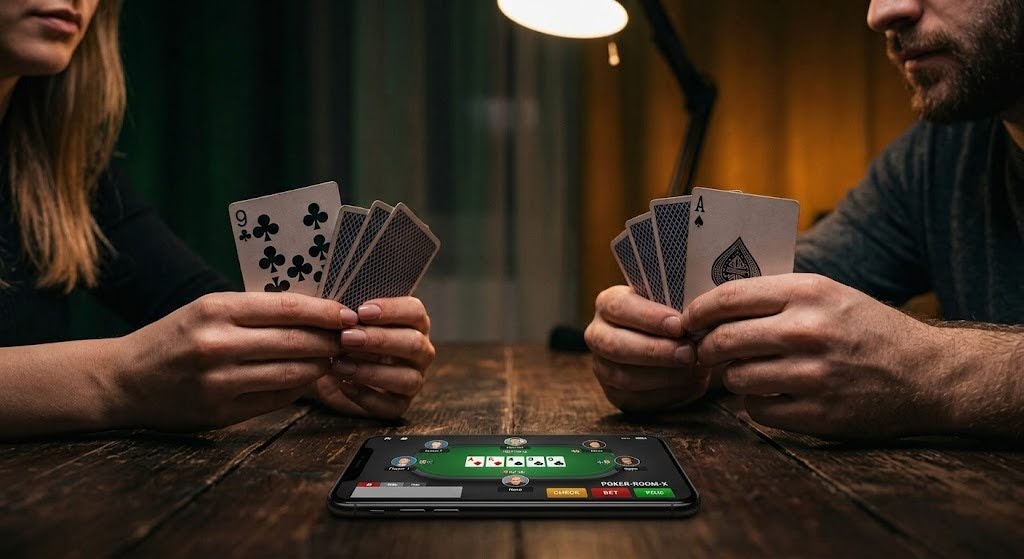
It emphasises different elements of poker. Position and postflop play become more important. There are no hiding spots with a full table. Quickly exploitable tendencies get exposed.
What Makes Heads-Up Poker Different?
As far as rules go, the main thing to know about heads-up poker is that you have to make a ton more decisions. At a full-ring table, folding a weak hand can be part of the strategy. When you play heads-up, you can’t fold hands like that too often or your opponent can just take pots uncontested.
This makes hand ranges a lot wider. Hands that are easy folds at a full table can be played at heads-up. Just because you can play a hand aggressively doesn’t mean you have to. Oftentimes a hand has to be played based on the context of the situation.
Also, because of the structure of heads-up play, there’s a constant struggle to gain the initiative. It’s important to be able to win a pot and then be able to defend it.
Heads-Up Poker Strategy Is About Adaptation
Like no limit hold’em, there is not a single strategy that works against every kind of opponent. The most important thing is understanding your opponent, how they behave, what kind of hands they have, etc.
It takes a mastery of a ton of different heads-up poker strategies and blending them together to create something to beat your specific opponent.
Let’s say your opponent folds a lot to raises but then turns aggressive after calling pre-flop raises. Being rigid and strict with one approach wastes the biggest edge you have when playing heads-up: the opportunity to develop a real read against one player. Rarely entering the pot needs a different approach than a player who calls everything; fighting an aggressive player too hard creates needless variance; giving too much room to a passive player will result in them seeing a lot of cheap flops.
Good adjustments come from trends, not lone hands. How often do they enter pots? What do they do to raises? How do their bet sizes and aggression shift throughout the streets? Don’t get stuck on one idea or approach, though; a player will defend their folds if they notice you exploiting them. It takes discipline to decipher if a trend is an actual long-term tendency or if it’s just a short-term fluctuation due to randomness.
Position Matters Even More Heads-Up
In all poker formats position is very important but it is most glaring with two players left. Because the button and blinds alternate between the players, you will get the advantage of acting last a lot; especially if you are able to identify which hands to raise. Having that advantage means you get to see what your opponent has before you have to act yourself.
This advantage influences a number of things including pre-flop and post-flop play. For example, against a player who recognizes positional advantage, a hand which would typically get raised from one position may not get raised from the other. Everything from how much pressure is applied, how hands are raised and played post-flop, how a player responds to aggression all shift based on position. Learning how to play heads up poker properly takes more than recognising the starting hands; context is important.
Heads-Up Poker Tips for Reading One Opponent
In head to head online poker, one advantage you have is you can study your one and only opponent in extreme detail because your attention isn’t split between multiple opponents. There are certain tendencies you should look for in your opponent.
These might include:
- Their frequency of raising or calling preflop.
- Do they defend against frequent aggression?
- Do they make large bets or raises after losing a large pot?
- How do bet sizes relate to strength of their hand?
- How often do they continue with a hand after missing the flop?
- Do they change their aggression later in a hand?
In online games, there can be a lot of potential tells, but in reality, most tells aren’t very useful. A fast game or a long pause can mean a lot of different things, including distractions or a laggy connection.
A tell only becomes useful when you observe it consistently.
Heads-Up Sit and Go vs Cash Games
In heads up cash games and heads-up sit-and-go tournaments, there are similar skills required, but the strategies required are different.
In a cash game, your chips can be worth a different monetary value depending on how many chips your opponent has. In a heads up sit and go, chips become more valuable as the game progresses due to increasing blinds.
Most skills needed for cash games are the same as needed for tournament play. This includes reading your opponent, spotting and understanding positional plays, establishing the right ranges and implementing the right amount of pressure. One hand can play differently at a cash game than at a tournament, because of cash game dynamics.
Why Heads-Up Poker Exposes Weaknesses Quickly
One of the reasons heads-up poker feels like a grind, is that there are not as many “lay down hands” at a cash game like there are at a full table game. A player at a full table can afford to play exclusively with premium hands. At a cash game, that player is constantly forced to make decisions about whether to fold.
Post-flop leaks crop up just as quickly. A player can struggle to decide when to make post-flop calls against aggression and that same problem will keep resurfacing against the same opponent. The nature of the format leaves almost no room for players to take breaks and avoid tough situations.
If you want to play heads-up cash games online, BCPoker is one site where you can try this format out and compare it with others.
The Mental Side of Heads-Up Play
There is a heavy mental aspect of playing heads-up cash games for long sessions, because every hand takes on a larger meaning, and players can get the false impression they are always outplayed over longer sessions, when in reality they are not.
At a smaller table, you have less opportunity to redirect your attention, and at a larger table, you may be engaged in a different hand from your opponent. Heads-up play captures your focus on one player and the single evolving battle.
Tilt becomes a larger concern. The player becomes frustrated, causing him to make erratic decisions, such as excessive aggression or going for the quick stack.
Dealing with tilt and anger becomes as essential as range awareness and game theory in Heads-Up play.
Conclusion
In Heads-Up play, a player’s skill is challenged in several ways, such as larger ranges, more frequent decisions, and changes in position. Heads-Up play requires constant adjustment and focused aggressiveness.
Often, players do not recognize that they are, in fact, attacking every pot. They become uncomfortable with the rate of aggression required, and begin playing illogical and careless hands.
Recognizing patterns and making adjustments, as well as identifying when a player is becoming uncomfortable and/or frustrated, becomes as essential as game theory in Heads-Up play.