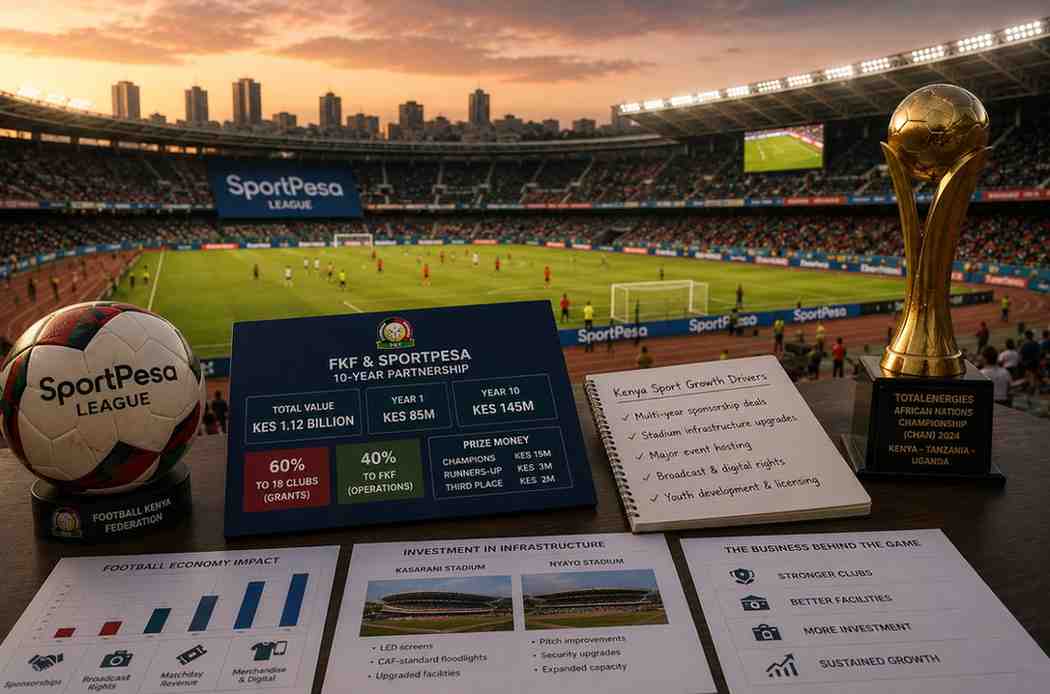
Various renovations as well as the rebranding of leagues and the signing of long-term commercial agreements have drastically altered the ways in which sport is financed and enjoyed in Kenya. The financial side of the game has now been structured with the same rigor as the fixtures, and Kenyan football is central to this. There is a commercial structure to the burgeoning business of sport in Kenya. For those who want to know where the money is in Kenya sport, think of the sale of broadcast rights, the signing of commercial agreements with sport federations, and the agreeing to host sport events — all are dominated by football.
Sponsorship Deals and the Football Economy in Kenya
The football economy received its clearest recent signal when the Football Kenya Federation (FKF) and SportPesa announced a 10-year agreement worth KES 1.12 billion for the top-flight league, rebranded as the SportPesa League from the 2025/26 season. According to FKF’s official federation structure, the body governs nine national competitions, but the Premier League remains the primary commercial asset.
The economics of this agreement further illustrate the role of sponsorship agreements in the financial sustainability of clubs:
- Year one payment of KES 85 million, increasing to KES 145 million in year 10
- 60% of the payment will be in the form of grants to the 18 clubs
- 40% of the payment will be retained by FKF
- Champions will receive a cash prize of KES 15 million, while KES 3 million will be awarded to the runner-up and KES 2 million to the third place club.
Because of this model, clubs now have the financial resources to plan for the payment of salaries as well as funding for travel and other operations. Clubs are no longer required to chase after handouts from sponsors.
Various other partnerships exhibit similar outcomes. The Mozzart Bet Cup and other women’s competitions feature additional sponsorship streams. Moreover, partners like Azam TV function as broadcasters and help popularize the competition outside the physical boundaries of the stadium. The sports business cycle is dependent on the media: sponsors pay, sponsors are seen, and followers sustain demand for sponsorship.
Sports Investment Flowing Into Major Events
Sports investments are focused on large events that combine sport with substantial economic investments. An example is that in 2024, Kenya is a co-host with Tanzania and Uganda of the TotalEnergies CAF African Nations Championship (CHAN). Group stage games and the Final will be held in Nairobi.
According to a report from the CAF, as of the last week before the tournament, the Kenyan authorities had completed Venue Security Assessments in preparation for the tournament on August 2 at both of the Final match venues, the Moi International Sports Centre, Kasarani, and Nyayo National Stadium. Kasarani hosted the Final on August 30.
Investments associated with large sports events in Kenya include:
- Sports Infrastructure — Improvement of stadiums, with the addition of LED screens and floodlighting to meet CAF standards, and increased size of team changing rooms
- Security and logistics — Government-led readiness checks before continental kick-off
- Regional hosting model — Shared costs and coverage of all East African Countries
- AFCON 2027 pathway — CHAN as the first practice run of the new African Cup of Nations competition framework
When the Harambee Stars dominated Group A, it was a success, although the on-field result was a quarter-final elimination. The business case was much more valuable. Hosting international events allows Kenya to host CAF events, bring in additional international investments, and vault Kenya to the forefront of international market investments.
How the Sports Business Extends Beyond Matchday
Kenyan football entails more than sponsorship deals and budget allocation. Matchday revenue and other financial activities allow the FKF to monetize fan engagement through the sale of merchandise and digital content and increase revenue through mobile engagement.FKF’s eFKF portal and FKF TV on YouTube and club licensing requirements testify how system administration has a place within this economy as a value creating system.
Three main factors explain the sustained growth within the market:
- Sustainable leagues — clubs are less likely to go bankrupt as a result of multi-year sponsorship agreements.
- A rapidly filling event hosting calendar — the upcoming AFCON 2027 is a result of preparation for CHAN 2024
- Professional standards — the requirement of youth teams for club licensing increases operational costs but increases the worth of the clubs
Football’s economic ecosystem dwarfs all others in the competition for private sponsorship agreements and broadcast deals, despite some indirect positive effects on other sports. Public attention and improved infrastructure due to the football calendar also positively impact athletics, rugby, and basketball.
Risks the Business Model Must Manage
The growth of the market does not lessen the need for governance. Fund accountability and league and match integrity are required for long-term contracts to be secure and for the system to expand. High-profile events bring security and ticketing system costs, as well as a requirement for maintenance after the event that will not be funded while the media remains.
Analysts watching the football economy consider how:
- Club grants build better teams and youth programs
- Upgraded stadiums stand the test of time past international tournaments
- Broadcast and digital rights develop after current agreements
Kenya sport is becoming a structured sports business led by football. The football economy is working via contracts, infrastructure, and media scale seen with the SportPesa League sponsorship, sports investments in Kasarani and Nyayo, and major events like CHAN 2024. There is no passion for this. The next challenge is understanding if the business foundation becomes better teams and improved venues to remain competitive on an international scale.