The FIFA World Cup always remained a tournament characterised by tradition, history and numbers. For many years football analysts used pre-set patterns to predict results, assess contenders and evaluate underdogs. It is true that FIFA World Football Cups are the biggest and most popular events. However, the 2026 FIFA World Cup brings a challenge like no other.
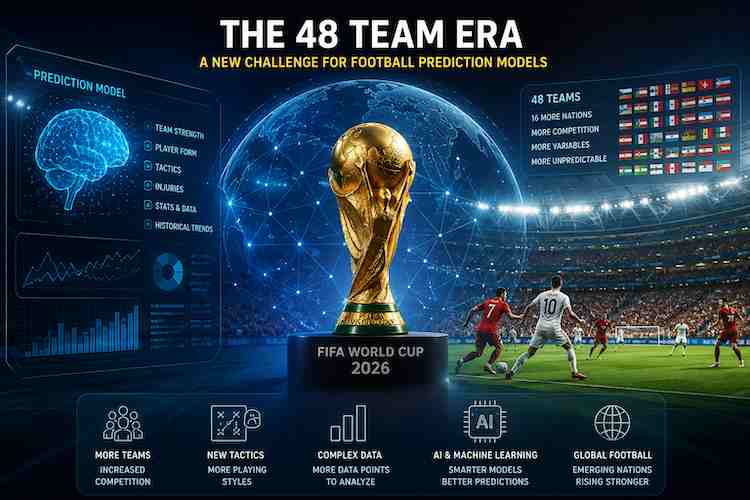
For the first time in history, football’s biggest prize will have 48 nations battling for it. Increasing the participant teams from 32 to 48 doesn’t merely mean a team influx. It alters the very nature of competition and requires analysts to revise their methodology for predicting results.
As fans gear up for a summer of football across the US, Canada, and Mexico, prediction professionals are preparing for a tournament that may be harder to predict than any World Cup before it.
Why the New Format Changes Everything
The World Cup traditional format gave analysts over 30 years of data for comparison. You could study tournament trends, group-stage performance patterns, and knockout-stage probabilities in a fairly consistent framework.
The 2026 edition redefines that structure.
The competition will feature nations which rarely appear on football’s biggest stage with the entry of 16 more teams. A lot of teams do not have much experience of the World Cup so their historical records in the tournament won’t help much now.
This causes uncertainty for prediction models. World Cup performances of the past will not hold as much weight for analyst predictions given the lack of pedigree of many teams.
The focus has shifted to qualification campaigns, recent international performance, player quality and tactical consistency.
More Teams Mean More Complexity
The expanded tournament introduces a wider range of variables than analysts have previously encountered.
Greater Tactical Diversity
Amongst the most interesting aspects within the new format has been the variety of styles of football.
Different continents approach matches in different ways: Africa, Asia and Oceania, North America and Europe. Some depend on defensive discipline and compact patterns. Some focus on taking the ball, pressing or transitioning fast.
There’s a need for broader simulations and computational models for tactical identities. Recognizing how these styles interact is becoming increasingly important when forecasting results.
Larger Differences in Team Quality
The enlarged pool furthers the prospect of clashes between footballing giants and more inexperienced countries.
At first glance, these games may seem predictable. Underdogs causing problems has been seen in World Cup history, all because of motivation, organization, and opportunity clash.
The analysts must establish whether the apparent quality gaps are indicative of what will transpire on the pitch or if there could be an upset in the making.
Squad Depth Becomes More Important
An extended and challenging competition entails added importance on the management of squads.
As the competition unfolds, teams boasting robust benches and diverse tactical choices will have a substantial edge. Fatigue, player rotation, injuries, and suspensions will have a greater say this time around.
Consequently, prediction models are starting to incorporate squad depth rather than just team lineups.
Historical Data Is No Longer Enough
For many years, historical data has been the basis of football forecasting models.
Historically, past World Cups, head-to-head records, and longer tournament trends have proven quite helpful indicators. Nonetheless, the extended format dilutes the predictive capacity of some of these metrics.
Numerous new nations have never faced elite nations in a World Cup environment. Why has their appearance changed so much?
Analysts can no longer rely solely on the tournament’s history, but rather recent evidence.
More and more information is being gleaned from club performances, international friendlies, continental championships and qualification campaigns.
Advanced Statistics Are Taking Center Stage
The analysis of modern football is much more than just goals and points.
Contemporary prediction models analyze a diverse set of advanced metrics such as expected goals, pressing efficiency, ball progression, defensive actions, and chance creation.
These statistics give a further insight to team performance and can often show a weakness or strength not reflected in the numbers.
For countries that have not had much World Cup participation, advanced metrics may provide the clearest sense of their actual ability.
The tournament’s expansion will likely enhance the relevance of data-driven analysis in the future.
Emerging Nations Could Become the Tournament’s Biggest Story
With the expanded World Cup, we will see more countries from the non-traditional elite of football represented – that is so exciting.
Over the last decade, many of these countries have invested a tremendous amount in youth development, coaching, and infrastructure. Consequently, many are arriving at the tournament more powerful than previous years have suggested.
To analysts, these teams are an opportunity, but also a challenge.
Even without a top soccer history, a nation can still possess good players in top European leagues. Some players have tactical systems which make them tough to beat even if the world doesn’t acknowledge them.
One of the key elements of accurate tournament prediction may be identifying which growing nations will outperform expectations.
Artificial Intelligence Is Reshaping Football Forecasting
Artificial Intelligence is changing the game and has become a powerful tool in football.
Sophisticated systems are capable of processing thousands of data points at once, finding patterns that would be hard for humans to pinpoint. Analyse player performances, team formations, possible injuries, the players’ travel schedules and much another.
Due to the amount of data that the enlarged World Cup generates, it is an excellent event for data-driven predictions.
As the number of teams entering the competition increases and the number of things that can change the result increases, a smart analytical system can help identify opportunities and result prediction.
A New Era for Football Predictions
The upcoming 2026 FIFA World Cup is perhaps the biggest change in the history of international football.
The new 48-team format gives nations around the globe new opportunities. However, it also brings some uncertainty for analysts and forecasters.
Businesses are experimenting with forecasting methods that are traditional. Though historical data is still valuable, it cannot provide all the answers anymore. Today’s success is dependent on blending knowledge of football with statistical powers, technology, and better understanding of world football.
With the tournament looming, one thing is for sure As the World Cup enters a new phase, so must football prediction models.