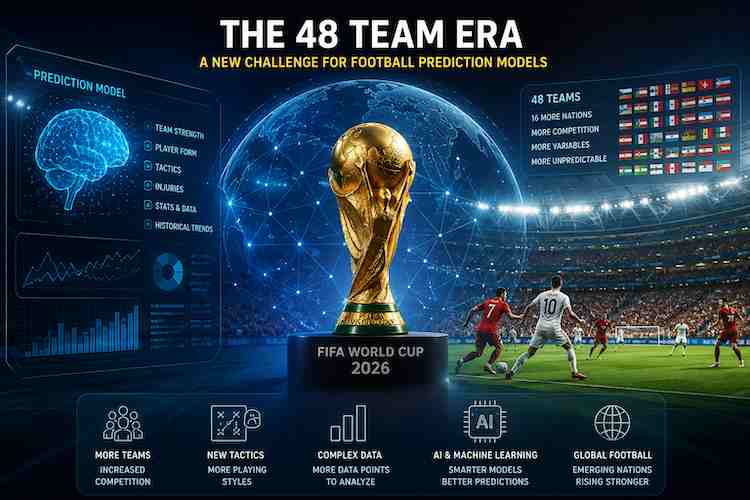
As football fans, we are hard-wired to believe that when it comes to our sport, we can predict anything. In fact, we are so convinced that we can anticipate the outcome of games that some put thousands of pounds into it becoming a reality. In very few other spheres would you find fans with so much confidence (or delusion).
Why Everyone Thinks They Can Predict the World Cup (And Why They’re Usually Wrong)
However, if the 2026 World Cup has taught us anything, it is that you must expect the unexpected. Hands up if you predicted Cape Verde drawing with former world champions Spain and Uruguay? Did anyone foresee South Africa coming from nowhere to finish second in Group A, reaching the knockouts in the process? We doubt it.
It seems that the 2026 tournament scriptwriters ripped up their initial notes and drew up a completely different story, one with more twists and turns than the Serpentine. Then again, we shouldn’t be surprised. When has anyone actually been consistently successful with their predictions? And why, despite our many favours, do we keep on trying?
World Cup Variety
Speaking as a Premier League fan, club football is significantly easier to call than the international game.
Given that we watch English football week in, week out, year after year, we understand where the momentum is going, who is going to achieve, and who is going to underperform. Although we don’t always get it right (just look at my fantasy team), we certainly have more of a chance than on the international stage.
That is because, although we do periodically see national sides play throughout the season, we don’t have the same sample size as we get with domestic football, while our lack of familiarity with non-European sides, such as Ghana, means that when they play, their outcomes are significantly less predictable.
Playing a part too is the pressure of competing for your country on the biggest stage of all. Over the 96-year history of the tournament, we have seen that pressure manifest itself in a myriad of different ways.
Headbutts, star performances, absolute horror shows and terrible lapses in judgement – you just have absolutely no idea who that pressure is going to affect and how. It seems to strike irrespective of how illustrious a nation is, only adding to the unpredictability.
Designed for Chaos
The point of the World Cup is to inspire as much drama as possible. What the tournament stands for and what it means regardless of whether a country has won it five times or is making a debut at the competitions means that each and every game is played with a title race passion and relegation battle fervour.
Three group stage matches – one bad result, and your hopes suddenly hang in the balance. In the knockouts, just one sub-par half of football can end even the finest of campaigns – it’s the beauty of knockout football.
We have seen it many times in the FA Cup back here in England, where big sides, suddenly wary of the fact they are just 90 minutes from going home, start to play within themselves , while their lesser opponents, spurred on by the apparent lack of engagement, play as if they have nothing to lose.
We know it as “the magic of the cup”, but when the Jules Rimet Trophy is on the line, we simply call it “what the World Cup is all about”. The lack of predictability is exactly what is the most watched sporting event on earth.
Tactical Variation
At a more tactical level, the World Cup provides plenty of interest to the fans of a more nuanced side of the game, namely where individuals are played on the pitch.
Of course, there are obvious selections: Harry Kane up front for England, Achraf Hakimi in his advanced right-back role for Morocco, and Mbappe leading the line for France. However, there have been some rather more confusing positional decisions made just two matchweeks into the tournament.
Ousmane Dembele’s use as a cross between a right winger and CAM is chief amongst them. The Ballon d’Or winner has been used as a false nine striker for PSG all season long and, has absolutely thrived in that role as the Parisians won their second consecutive Champions League, as well as the Ligue title.
Though he has played as both a right winger and an attacking midfielder at various stages of his career, the sudden shift back into the role after a number of years away from it has affected the impact he has on the game.
Ineffective in France’s opener against Senegal, and while he scored and assisted against Iraq in their second, it was Iraq – hardly the trickiest opponent at the tournament and ranked 59 places below them in the FIFA world rankings.
Natural, Mbappe has to start ahead of him, but there is a possibility that later on in the tournament, Dembele’s lack of influence could impact France more notably, and the same can be said of other questionable positional decisions, such as Thomas Tuchel’s choice to start Anthony Gordon over Marcus Rashford, or the eternal debate about whether Portugal are stronger or weaker with Ronaldo up front.
An Issue of Ego
We attempt to predict the outcome of even the most random games because it’s fun – it’s something that can help bond new people, strengthen existing relationships, and do something enjoyable with other people in a social environment. If you end up being correct, the endorphin rush is almost incomparable to anything else.
For some, getting a prediction right earns them a token of competitive respect, meaning they can brag with lines like “I told you so” and “I knew it all along”. Harmless, if a little annoying, but fair enough if you call something unlikely before a ball is kicked.
However, it is this ego and the desire to predict something unpredictable that makes your chances of being right that much less likely. The more time you spend using analytics, stats and numbers to decipher which is the best value unlikely prediction, the more unlikely it becomes – it’s good old-fashioned sod’s law.
Regardless of whether ego is involved, making World Cup predictions is a fool’s game – anything can (and usually does) happen, and fans have next to no say in the matter, though looking for expert soccer prediction insights might help level the playing field.
However, that is never going to stop people doing it. Social predictions keep things interesting and mildly competitive, while from a betting standpoint, some punters stand to make enormous gains on the off chance they are right.
Like it or not, predicting outcomes at the World Cup is firmly intertwined with the tournament itself, and that is absolutely fine by us. Just prepare to be wrong more often than not!